
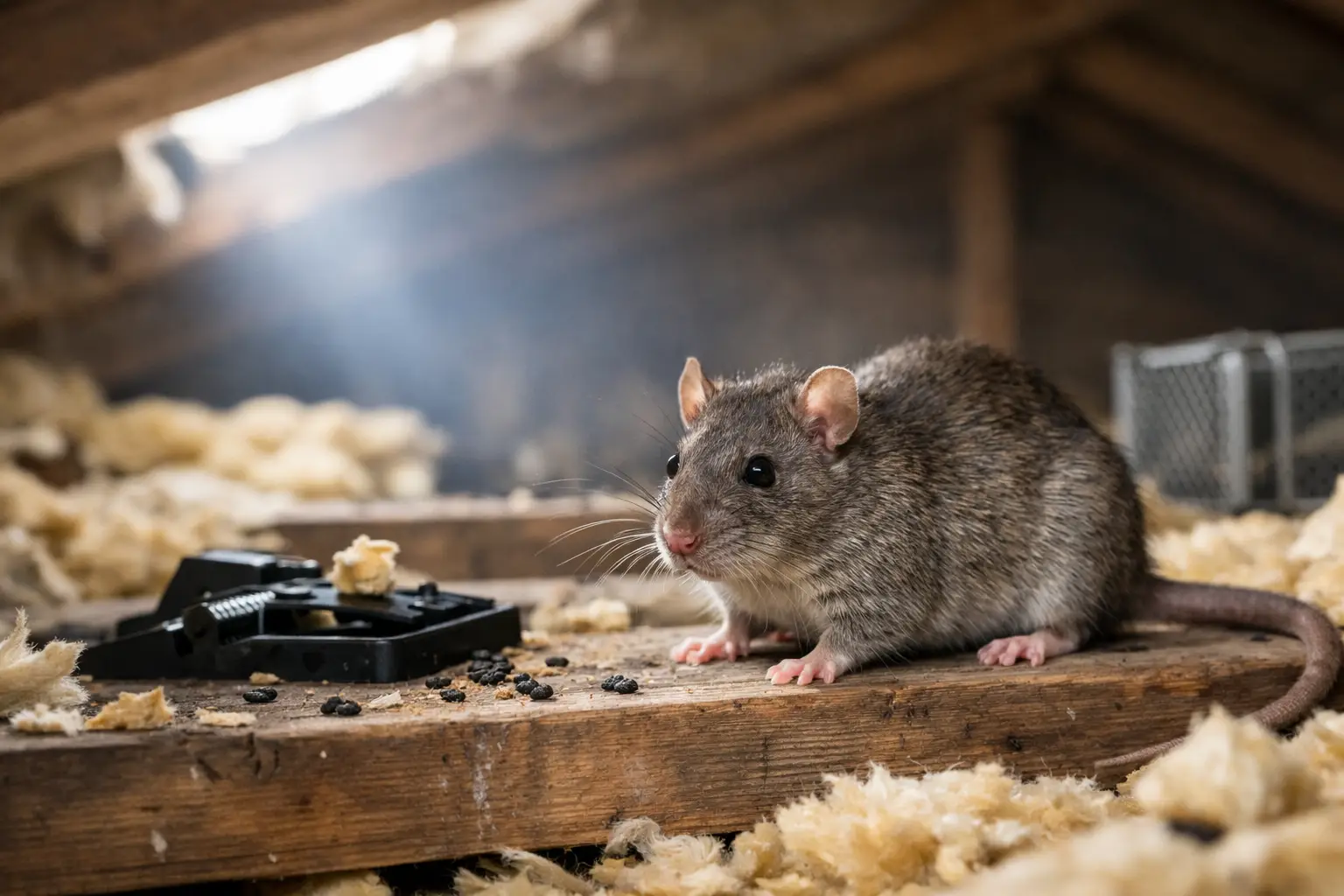
Hearing scratching above the ceiling at night is rarely a harmless nuisance. In most London properties, that pattern points to a rodent issue that will not improve on its own. This rat infestation in loft guide explains what the signs mean, why loft activity becomes serious quickly, and what to do if you need the problem dealt with properly and without delay.
Why rats choose lofts
Lofts give rats exactly what they need – warmth, shelter, darkness and quiet access routes. Once inside, they can move through insulation, nest near stored items, and travel along pipe runs, joists and cavity walls without being seen. In terraced and semi-detached properties, they may also move between adjoining buildings, which is one reason loft infestations can grow before anyone realises how active they are.
In colder months, loft spaces become even more attractive. A small gap at the eaves, a damaged vent, or an opening around pipework is often enough. Rats do not need a large access point, and urban properties give them plenty of opportunities, especially where roofing has aged or external maintenance has been delayed.
Early signs of a rat infestation in loft spaces
The first sign is often noise. Scratching, scurrying, light thudding, or movement soon after dark usually indicates active rodents using the same routes each night. If the sounds become more frequent, that often suggests a settled infestation rather than a single visitor.
You may also notice droppings near stored boxes, insulation or access hatches. Rat droppings are typically dark, spindle-shaped and more substantial than mouse droppings. A strong, stale smell can build up in enclosed spaces, especially if nesting material, urine and droppings are present over time.
There are visual clues as well. Insulation may look churned up or flattened where rats have nested or travelled repeatedly. Cardboard, loft felt, wiring coverings and stored fabrics can all show gnaw marks. In some cases, residents notice stains on ceilings or around loft hatches caused by contamination above.
Why loft rats are more than a noise problem
Many people wait because the issue seems contained to the roof space. That is a risk. Rats in lofts can damage electrical wiring, contaminate insulation, and spread activity into wall cavities, kitchens, storerooms and service areas below. The longer they remain, the higher the chance of secondary damage and repeated access.
There is also the hygiene concern. Rat urine and droppings create unsanitary conditions, particularly in properties where loft spaces are used for storage. If the infestation reaches food areas in homes, cafés, offices or commercial premises, the issue becomes more urgent from both a health and compliance point of view.
For landlords and business operators, delay can become expensive. A minor loft problem can turn into a wider building issue that affects tenants, staff or customers. Fast action is usually the cheaper and safer option.
What causes rats to get into a loft
Entry points are the main reason, but not the only one. Rats are persistent and will exploit weak spots around rooflines, fascia boards, damaged vents, broken tiles and gaps around utility penetrations. Overhanging branches can also help them reach roofs more easily.
Food pressure matters too. If external bins are unsecured, pet food is left accessible, or there is general waste build-up near the property, rodent activity around the building increases. Once rats are established outside, loft access becomes far more likely.
Neighbouring infestations can also play a part. In built-up areas such as Wembley, Ealing or Camden Town, rats do not recognise property boundaries. If one building has active rodent pressure, nearby lofts and roof voids may become part of the same movement route.
What to do as soon as you suspect loft rats
Start by avoiding direct contact with droppings, nesting material or damaged insulation. Do not sweep dry droppings or disturb contaminated areas without proper precautions, as that can spread particles into the air. If you need to inspect the loft, wear suitable protective clothing and keep the visit brief.
Make a note of what you have seen and heard. The time of day, location of sounds, visible droppings, gnaw marks and possible entry points all help build a clearer picture. For commercial properties, documenting signs early also supports faster decision-making and more accurate treatment planning.
What you should not do is rely on guesswork. DIY products may catch one or two rats, but they rarely solve the whole problem if the access point remains open or the nesting area is not identified. In loft infestations, the real issue is not only removing the rodents – it is stopping the property from remaining attractive and accessible.
A practical rat infestation in loft guide to treatment
Professional loft treatment usually starts with a detailed inspection. That means confirming whether the activity is definitely rats rather than mice, squirrels or birds, identifying likely entry points, assessing the scale of infestation, and checking how far the problem has spread within the structure.
From there, treatment depends on the property and the urgency. In some cases, trapping is appropriate. In others, a wider rodent control plan is needed, especially where activity is established across multiple access routes or linked to external harbourage. There is no single fix that suits every loft, and that is where proper assessment matters.
Exclusion work is a key part of long-term control. If rats can still get in, any initial treatment may only provide temporary relief. Sealing gaps, improving proofing around vents and pipe entries, and addressing external vulnerabilities often make the difference between a short-lived result and a lasting one.
After treatment, contaminated nesting material and damaged insulation may need attention. This depends on the extent of the infestation. Some lofts only need targeted cleaning, while others require more substantial aftercare because odour and contamination can continue to attract pests if left in place.
Why DIY can fall short
People often try bait or traps from a shop before calling for help. That is understandable, but loft infestations are awkward. Access is limited, movement routes are hidden, and rodents often avoid poorly placed products. If a rat dies in an inaccessible area, you may then be dealing with odour as well as the original infestation.
There is also a safety issue. Homes with children or pets need careful product placement, and commercial sites need a treatment approach that does not interfere with operations or create further hygiene concerns. A rushed DIY attempt can make the situation harder to manage, not easier.
Professional control is not just about stronger products. It is about locating activity properly, choosing the right method for the setting, and reducing the chance of the problem returning.
Preventing rats from coming back
Good prevention is practical rather than complicated. The building envelope matters most. Roof defects, loose vents, broken soffits and unsealed pipe entries should be dealt with quickly. If previous proofing has failed, it is worth reviewing why, because rats will often test the same weak spots repeatedly.
External housekeeping also matters. Keep bins closed, avoid leaving food waste accessible, and clear clutter near walls and outbuildings where rodents can shelter. If you store belongings in the loft, use sealed containers where possible instead of open cardboard boxes or loose fabrics.
For some properties, ongoing monitoring is sensible. This is particularly true for landlords, restaurants, storage facilities and older buildings where structural vulnerabilities are harder to eliminate completely. A one-off treatment can solve the immediate issue, but prevention is what protects the property over time.
When to call for urgent help
If you are hearing regular loft activity at night, finding fresh droppings, noticing chewed wiring or smelling a strong rodent odour, it is time to act. The same applies if tenants are reporting repeated noise, or if your business premises could be affected by contamination or reputation risk.
Urgency matters because rats breed quickly and move confidently once settled. What starts as occasional scratching can become a larger infestation across the loft, wall voids and lower floors. For homes and businesses alike, early intervention usually means less disruption and lower repair costs.
A qualified pest control team can inspect the loft, confirm the source, carry out treatment safely, and advise on proofing that fits the building. That is the kind of practical support customers expect from a service-led company such as Golden Pest Control, especially when the problem cannot wait until normal working hours.
If there is one useful rule to keep in mind, it is this: loft rats are easiest to deal with when you respond to the first signs, not the fifth night of lost sleep.