
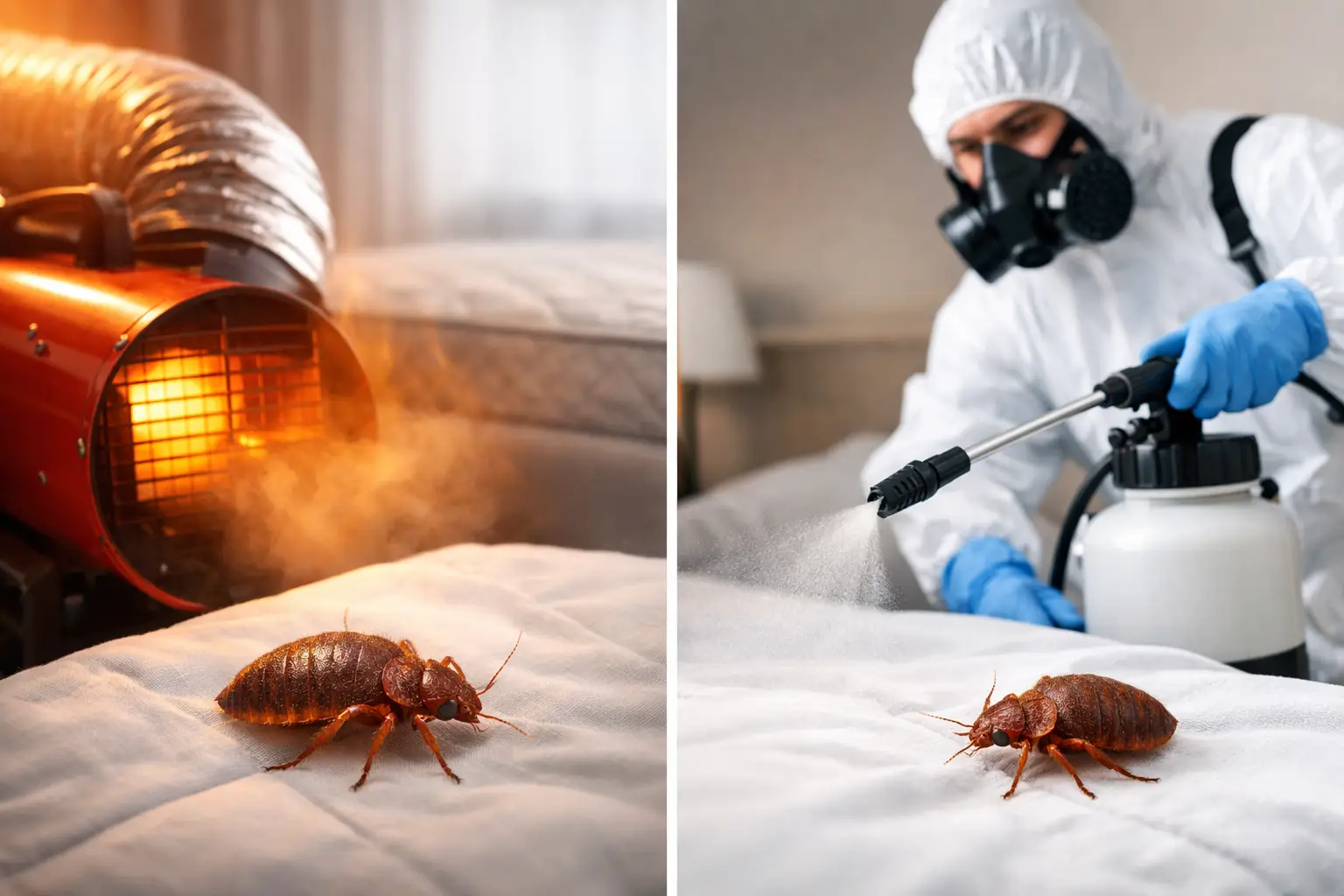
You usually find out you have bed bugs at the worst possible moment – after a broken night’s sleep, fresh bites, or a guest quietly mentioning they saw something on the mattress. When people ask about heat treatment vs spray bed bug solutions, they are usually not looking for theory. They want to know what works, how fast it works, and what gives them the best chance of getting their property back to normal.
The short answer is that both methods can work, but they solve the problem in different ways. The right choice depends on the scale of the infestation, the type of property, how quickly treatment is needed, and whether the room can be prepared properly for the chosen method.
Heat treatment vs spray bed bugs: what is the difference?
Heat treatment raises the temperature in the affected room or property to a level that bed bugs cannot survive. This includes adults, nymphs, and eggs, which is one of the main reasons it is often chosen for more serious infestations. The aim is to push heat deep into mattresses, bed frames, skirting areas, soft furnishings, and cracks where bed bugs hide.
Spray treatment uses professional-grade insecticides applied directly to known harbourage points and movement areas. This might include bed frames, seams, furniture joints, skirting boards, flooring edges, and nearby hiding spots. The treatment is targeted rather than whole-room in the same sense as heat, and it usually relies on both direct contact and residual action over time.
Neither option is automatically better in every case. A small, localised infestation in one bedroom may respond well to a professional spray treatment. A larger infestation spread across multiple rooms may be better suited to heat, particularly where rapid knockdown is a priority.
When heat treatment is the stronger option
Heat treatment is often chosen when speed matters and the infestation appears well established. Because bed bugs and their eggs die at sustained high temperatures, heat can deal with life stages that are often harder to manage with chemical-only approaches.
This makes it especially useful in properties where bed bugs may be hiding in multiple places, not just on the bed itself. In a London flat or shared accommodation, for example, bugs can move into sofas, wall voids, bedside units, luggage, and clothing storage. Heat gives broader coverage in one operation, provided the treatment is set up properly.
Another advantage is reduced dependence on residual chemicals in sleeping areas. That can be appealing for some households and some business environments, although a technician still needs to assess what is safe and suitable for the property.
That said, heat treatment is not magic. It depends heavily on preparation, equipment, room layout, and technician experience. Clutter can create cooler spots. Some items may need to be removed or protected. If the property is not prepared correctly, bed bugs can survive in insulated hiding places. A proper inspection matters just as much as the treatment itself.
When spray treatment makes more sense
Spray treatment is often a sensible option where the infestation is caught early, remains limited to a defined area, or where heat treatment is not practical. It can also be more budget-friendly at the outset, which matters for many tenants, landlords, and businesses balancing urgency with cost.
A professional spray programme is not the same as using an off-the-shelf aerosol from a supermarket. Store-bought products often scatter bed bugs deeper into hiding and rarely solve the issue fully. Professional application is based on inspection, identification of harbourages, and use of appropriate products in the right places.
The other benefit of spray treatment is residual control. Depending on the product and surface, insecticides can continue working after the visit, helping to catch bugs that emerge later from hiding. This is why follow-up visits are often built into a bed bug plan. Unlike heat, which aims for immediate full elimination, spray treatments may work in stages.
This is also where expectations need to be realistic. Spray treatment usually takes longer to complete the job. Eggs may hatch after the first visit, and more than one attendance is often needed. If a customer wants one fast intervention and minimal wait time for results, heat may be the better fit.
Cost, speed and disruption
For most customers, the comparison comes down to three practical questions: how much will it cost, how quickly will it work, and how disruptive will it be?
Heat treatment usually costs more upfront. The equipment, labour, monitoring, and preparation are more intensive. In return, it often offers faster results and may reduce the need for repeated visits when the treatment is appropriate and carried out correctly.
Spray treatment is generally less expensive initially, but it can involve a series of visits and a longer treatment window. That may still be the right choice, especially for smaller infestations or properties where heat is not suitable.
Disruption varies as well. Heat treatment can involve significant preparation, temporary removal of heat-sensitive items, and time out of the treated area. Spray treatment also requires preparation and aftercare, but in some cases the operational impact can be easier to manage, particularly for selected rooms rather than an entire site.
For businesses such as hotels, hostels, offices, or serviced accommodation, downtime matters just as much as treatment price. A quicker reset may justify a higher upfront cost if it reduces lost bookings or reputational risk.
Heat treatment vs spray bed bugs in homes and businesses
In domestic properties, the right method depends on spread, occupancy, and how quickly the problem has been identified. If one room shows clear signs and the infestation appears recent, a spray programme may be perfectly effective. If several rooms are affected, family members are carrying bites from different sleeping areas, or furniture throughout the property shows activity, heat may offer a more decisive response.
For landlords and letting agents, the timeline is often compressed. Vacant properties may be easier to treat with heat because access and preparation can be controlled more easily. Occupied homes may require a more tailored approach based on resident vulnerability, room access, and the need to keep disruption manageable.
In commercial settings, there is an added layer of compliance, customer confidence, and continuity. Businesses cannot afford vague advice or half-measures. A restaurant staff room, office soft seating area, or hospitality bedroom all need a treatment plan that considers access, safety, reopening time, and reputational sensitivity. That is where a professional assessment becomes essential rather than optional.
Why inspection matters more than the method alone
One of the biggest mistakes people make is choosing a treatment before confirming the extent of the infestation. Bed bug activity is not always limited to the obvious area. A few visible signs on the mattress do not tell you whether the problem is isolated or whether bugs have already spread to surrounding rooms.
A proper inspection helps answer the questions that actually matter. Are the bugs active in one bed or several? Is there evidence in sofas or adjacent rooms? Are there conditions making treatment harder, such as clutter, damaged furniture, or frequent movement of belongings between rooms?
Without that inspection, even a strong treatment choice can underperform. The issue is not just heat versus spray. It is whether the treatment matches the infestation you actually have.
The common trade-offs people should know
Heat is fast and broad-reaching, but usually more expensive and more dependent on careful setup. Spray is often more affordable and effective for selected infestations, but usually takes longer and may require repeat visits.
Heat can be attractive when people want a rapid result and wider whole-room penetration. Spray can be a practical route when the infestation is smaller, budget is tighter, or the property setup makes heat less suitable.
There is also a third point that gets overlooked: in some cases, the best results come from a combined strategy. A pest control professional may recommend one primary treatment supported by follow-up monitoring or targeted residual application. Good bed bug control is rarely about chasing a one-size-fits-all answer.
What should you choose?
If you need a simple rule of thumb, choose based on the size of the problem, not just the price of the treatment. Heat treatment is often the stronger option for heavier or more widespread infestations, for urgent cases, and where rapid knockdown matters. Spray treatment is often suitable for early-stage, contained infestations and for customers who can follow a planned treatment schedule.
The safest decision is to avoid guessing. Bed bugs spread easily through soft furnishings, luggage, clothing, and shared living spaces. Waiting too long or trying several DIY products first often makes treatment more complicated and more expensive later.
A clear inspection, honest advice, and a treatment plan that fits the property will always beat a quick fix bought in frustration. If bed bugs are disrupting your home, tenants, or business, the best next step is simple: act early, and make sure the method fits the infestation, not just the label on the treatment.