
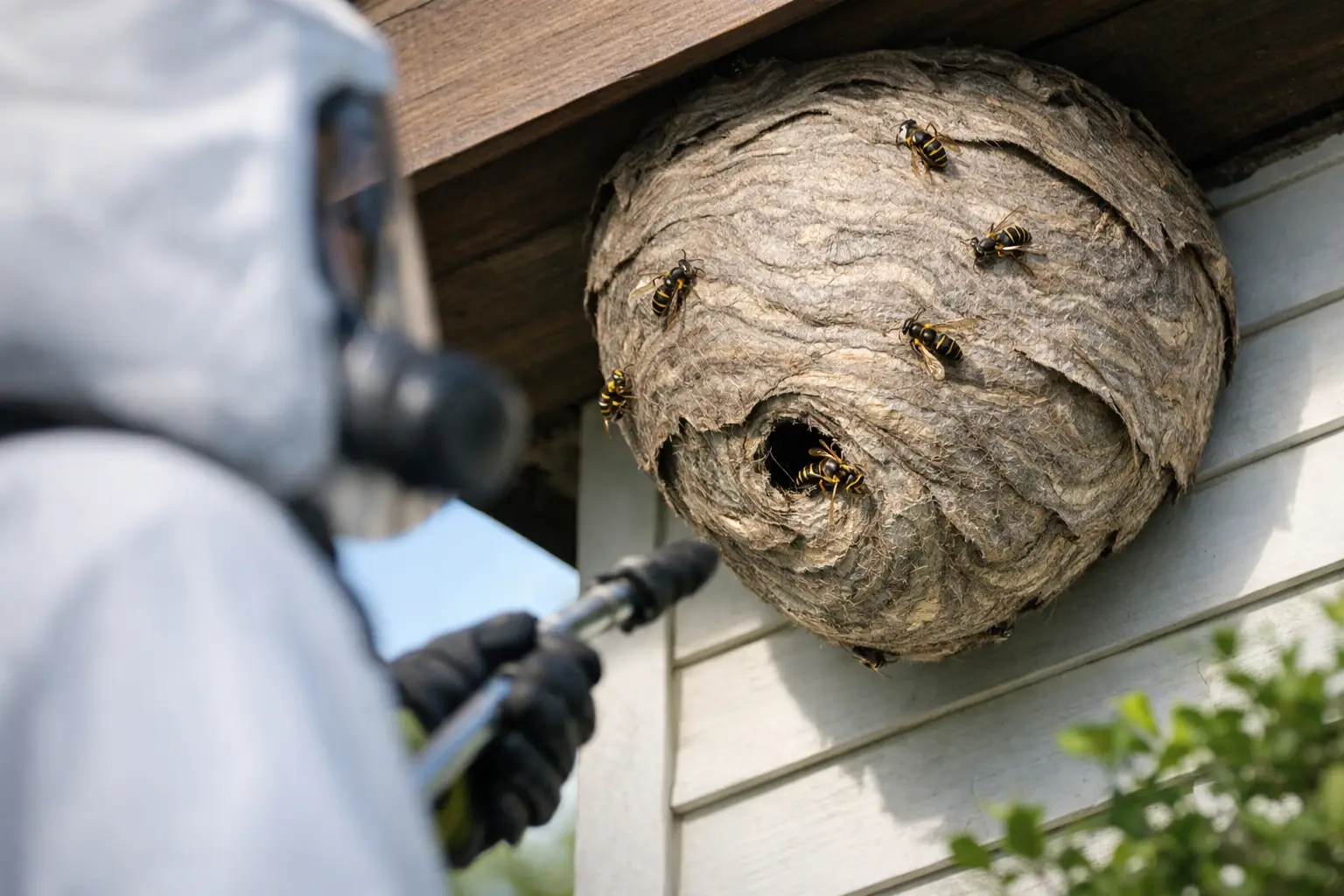
A small papery nest under the eaves can turn into a serious problem surprisingly quickly. If you are wondering when should wasp nests be removed, the short answer is this: as soon as they pose a risk to people, pets, access routes, or business operations. Waiting can mean a larger colony, more aggressive wasps, and a more difficult treatment.
That said, not every nest needs the same response on the same day. The right timing depends on where the nest is, how active it is, who uses the space, and whether there is an immediate danger. In a family garden, a loft hatch, a school entrance, an outdoor dining area, or a commercial bin store, the decision is usually less about the calendar and more about risk.
When should wasp nests be removed in practice?
In practice, a wasp nest should be removed when it is active and causing a genuine hazard. That includes nests near doors, windows, rooflines, lofts, sheds, children’s play areas, patios, and any area where people regularly pass or work. For businesses, the threshold is even lower. If staff, customers, tenants, or visitors are likely to come into contact with wasps, fast action is usually the safest option.
The busiest wasp period in the UK is typically from late spring through summer and into early autumn. Early in the season, nests are smaller and treatment is often more straightforward. By mid to late summer, a nest can contain a much larger number of wasps, which increases activity and the chance of stings. If you have spotted a nest in June, July, August, or September, it is usually sensible to deal with it promptly rather than hope it stays manageable.
There are exceptions. A nest at the far end of a large garden, high in a tree, and well away from people may not require urgent intervention. Even then, it should be assessed carefully. Wasps do not always stay in one neat flight path, and what looks distant enough one week can become a nuisance as colony numbers rise.
The best time of year to remove a wasp nest
Most wasp call-outs happen between summer and early autumn because that is when nests are most visible and activity peaks. If removal is needed, earlier is generally better. A small nest discovered in late spring is usually easier and safer to treat than a mature one found in August.
By late autumn or winter, many wasp nests become inactive. Social wasps usually do not reuse the same nest the following year, and the colony naturally dies off as temperatures drop. In that situation, an old empty nest may not need urgent professional treatment, though some property owners still prefer to have it removed for peace of mind or to confirm there is no remaining activity.
The key point is that season matters, but activity matters more. An active nest in summer should not be ignored just because it is “only small”. A dead nest in winter is less urgent than a live nest above your front door in July.
Early-season nests versus late-season nests
Early-season nests are often no bigger than a golf ball or tennis ball. They may be built in sheds, roof spaces, wall cavities, or behind fascia boards. These are worth addressing quickly because the colony can expand rapidly.
Late-season nests tend to produce more visible traffic, louder buzzing, and more defensive behaviour. They can also be harder to access safely if they are hidden in loft insulation, cavity walls, or high external points. This is often when people realise the problem has grown beyond a simple nuisance.
Signs a wasp nest should be removed immediately
Some situations call for urgent action rather than watchful waiting. If anyone in the property has a known allergy to stings, the nest should be treated as a priority. The same applies where there are young children, elderly occupants, pets, or vulnerable residents who may not react quickly if wasps become aggressive.
Immediate removal is also advisable if the nest is close to entrances, windows, air vents, paths, balconies, garden seating, or work areas. In commercial settings such as cafés, shops, schools, warehouses, and rental properties, even a moderate level of wasp activity can create a health and safety issue. A single sting incident can be more than a nuisance – it can disrupt operations, alarm customers, and expose a business or landlord to avoidable risk.
Another warning sign is unusual wasp behaviour indoors. If you are seeing wasps repeatedly in an upstairs room, loft conversion, or near ceiling lights, there may be a nest in the roof void or cavity. That usually means professional inspection should happen sooner rather than later.
When it might be safe to wait
There are limited cases where immediate removal may not be necessary. If the nest is clearly inactive, located far from any occupied area, and presents no realistic chance of contact, there may be no need for urgent treatment. Some owners choose to leave an old winter nest in place until other maintenance is carried out.
But waiting only makes sense when risk is genuinely low. If you are unsure whether a nest is active, hidden, or likely to affect access, it is better to have it assessed. Guesswork around wasps tends to go wrong at the point someone gets too close.
Why DIY removal is risky
A common mistake is assuming a wasp nest can be knocked down, sprayed casually, or sealed over. That can make the problem worse. Disturbing an active nest often triggers a defensive swarm response, and sealing the entry point before treatment may force wasps into other parts of the building.
Lofts, cavity walls, rooflines, chimneys, and high eaves are particularly risky because access is awkward and visibility is poor. If the nest is established, the wasps will defend it. For homeowners, tenants, and staff, the cost of a rushed DIY attempt can be far higher than the cost of having it handled properly.
Professional treatment is not just about removing visible nest material. It is about identifying the nest location, judging its activity, applying the right treatment safely, and reducing the chance of further issues around the property.
What property owners and businesses should consider
For households, the biggest question is usually safety around daily life. Can children use the garden? Can windows stay open? Is it safe to go into the loft or shed? If the answer is no, there is little benefit in delaying treatment.
For landlords and managing agents, speed matters because minor pest issues can escalate into tenant complaints very quickly. A reported wasp nest near an entryway, bin area, or roofline should be taken seriously, especially during peak season.
For businesses, there is also reputation to consider. Wasps around seating areas, deliveries, staff entrances, or customer-facing spaces can create an immediate operational problem. Restaurants, cafés, schools, care settings, offices, and warehouses all need a fast, clear response when stinging insects become active on site.
In areas such as Wembley, Harrow, Ealing, Hendon, or across wider London, densely built properties can make wasp problems more awkward because nests are often close to neighbouring access points, shared gardens, or adjoining roof spaces. That is another reason not to leave an active nest unchecked.
What happens after treatment?
After professional treatment, activity usually drops as the insecticide takes effect, though you may still see some wasps returning to the nest for a short period. That does not necessarily mean the treatment has failed. It often takes a little time for the colony to become fully inactive.
The physical nest itself is not always removed immediately, especially if it is in a difficult void. In many cases, once inactive, it can be left safely in place if access is limited. If removal is practical and helpful, that can be arranged, but the priority is always to stop the risk from live wasps.
It is also worth checking for attractants around the property afterwards. Damaged soffits, gaps into roof spaces, open vents, and sheltered corners can all provide appealing nesting spots. A good pest control visit should not leave you guessing about what happens next.
When to call a professional
If the nest is active, hard to reach, indoors, near a busy area, or linked to repeated wasp sightings inside the property, call a professional straight away. The same applies if anyone on site has a sting allergy, or if the property is commercial and public-facing.
Golden Pest Control handles urgent wasp issues with the same priority property owners and businesses expect from a rapid-response pest service: clear advice, safe treatment, and practical next steps. When wasps are affecting your home, tenants, staff, or customers, a fast professional response is the sensible move.
A wasp nest rarely becomes easier by being ignored. If it is active and close to everyday life, the safest time to deal with it is usually now, before a manageable problem turns into an emergency.