
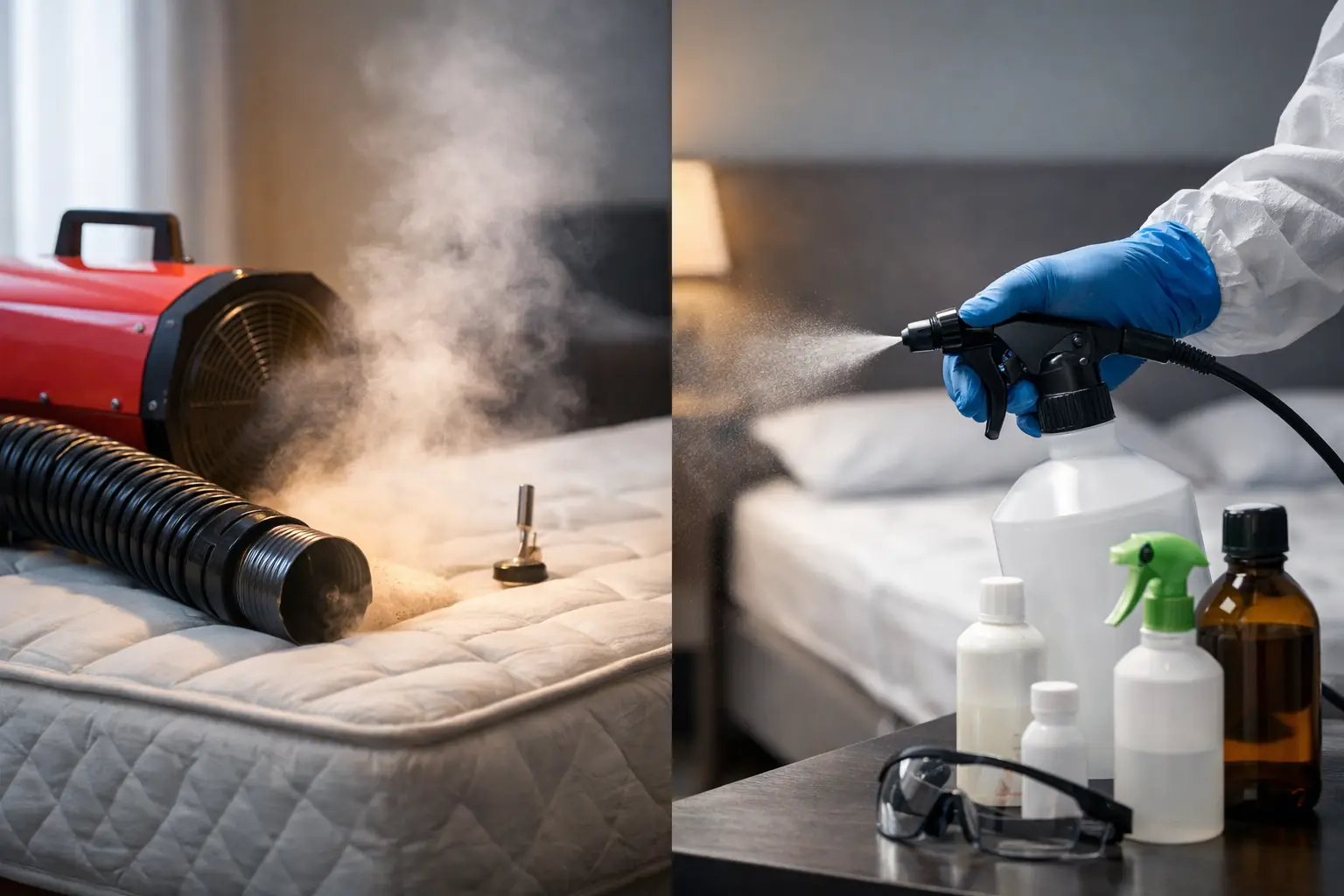
When you are dealing with an active infestation, the question is rarely academic. Heat treatment vs chemical treatment becomes a practical decision about how quickly the problem can be controlled, how disruptive the process will be, and what gives you the best chance of stopping it from coming back.
For most people, this choice comes up with bed bugs and fleas, though it can also matter in wider pest control planning. The right answer depends on the pest, the size of the infestation, the layout of the property, and who uses the space. A family home, a rented flat, a hotel room and a restaurant storage area all have different pressures. What matters is choosing a treatment that is effective, safe and realistic for the situation in front of you.
Heat treatment vs chemical treatment: what is the difference?
Heat treatment uses controlled high temperatures to kill pests across all life stages, including eggs in many cases. In professional pest control, specialist equipment raises the temperature in the affected area to a level pests cannot survive. The aim is to reach the hidden spaces where insects shelter, not just the surfaces you can see.
Chemical treatment uses approved insecticides or other pest control products applied to key areas such as cracks, crevices, skirting boards, bed frames, soft furnishings or entry points. Depending on the pest, this may involve sprays, dusts or targeted residual products that continue working after application.
Neither approach is automatically better in every case. Heat can offer a fast knockdown, while chemicals can provide longer residual protection. In some infestations, the strongest result comes from combining both.
When heat treatment is often the stronger option
Heat treatment is most commonly associated with bed bug control, and for good reason. Bed bugs hide deeply in mattresses, bed frames, sofas, flooring edges and furniture joints. Because heat penetrates many of these harbourage areas, it can reach pests that might otherwise avoid direct contact with a spray.
A major advantage is speed. In many cases, a professional heat treatment can address a bed bug problem in a single visit, though the severity of the infestation still matters. That makes it attractive for households that need quick results, and for businesses where downtime carries a real cost.
Heat also reduces reliance on chemical products. That can be helpful in settings where there are concerns about repeated insecticide use, or where sensitive occupants are present. It does not mean the process is casual or risk-free – professional setup and monitoring are essential – but it can be a very clean and direct method when used properly.
Another strength is effectiveness against eggs. Some chemical treatments struggle because eggs can survive the first application and hatch later, which is one reason follow-up visits are often needed. Heat, when applied correctly and sustained at the right temperature, can deal with multiple life stages at once.
Where heat treatment has limitations
Heat sounds ideal, but it is not the right fit for every job. It usually requires more preparation. Certain items may need to be removed or protected, including heat-sensitive belongings, electronics in some cases, candles, pressurised containers, plants and some plastics.
Property layout also matters. Clutter can interfere with airflow and reduce how evenly heat moves through a room. In larger or more complex buildings, it can be harder to ensure every hidden area reaches lethal temperature for long enough. If the treatment is not carefully managed, cool spots can remain.
Cost is another factor. Heat treatment often comes at a higher upfront price than a standard chemical application because it requires specialist equipment, monitoring and technician time. For some clients, that higher initial cost is justified by faster results. For others, especially where follow-up access is easy, a chemical programme may be more practical.
When chemical treatment makes more sense
Chemical treatment remains a core part of modern pest control because it is versatile, targeted and often cost-effective. For fleas, cockroaches, ants and certain crawling insects, professional chemical applications can be highly effective when combined with sanitation and proofing advice.
One of the main advantages is residual activity. A properly chosen product can keep working after the technician has left, which helps tackle late-emerging pests or insects moving through treated areas. That ongoing protection can be valuable in properties where complete immediate exposure is difficult.
Chemical treatment can also be more suitable for localised infestations. If activity is limited to one or two areas, a targeted application may solve the problem without the disruption of heating an entire room or property. For landlords, managing agents and businesses, that can mean lower operational impact.
In many cases, chemicals are also the more realistic option for repeat management. If a site has structural vulnerabilities, shared walls, stock movement or recurring pest pressure, a broader pest management plan may rely on residual products as part of ongoing control.
The trade-offs with chemical treatment
The main issue with chemical treatment is that success depends heavily on pest behaviour. The product has to be placed where the pest travels or hides, and some insects are very good at staying out of reach. Eggs may survive initial treatment depending on the pest and product used, which is why repeat visits are often necessary.
Preparation is still important. Residents or staff may need to vacate treated areas for a period, food items may need covering or removal, and cleaning routines may need adjusting afterwards so the treatment remains effective. Some clients assume a spray is a quick fix with no follow-up, but that is rarely the full picture.
There is also the issue of resistance. Certain pests, especially bed bugs and cockroaches, can develop resistance to some active ingredients. That does not make chemical treatment ineffective across the board, but it does mean product choice and application quality matter a great deal.
Heat treatment vs chemical treatment for bed bugs
If the infestation is bed bugs, this is where the comparison matters most. Heat treatment is often favoured for established bed bug activity because it can address hidden insects and eggs more quickly across a wider treated zone. For homes where bites are ongoing, multiple rooms are affected, or previous sprays have not resolved the issue, heat can be the stronger route.
Chemical treatment can still work well for bed bugs, especially in smaller infestations or where a staged treatment plan is more practical. It is commonly used with follow-up visits to catch newly hatched bugs and monitor progress. In some cases, this is the sensible option from both a cost and access point of view.
The best choice depends on what inspection reveals. If the activity is widespread, the property has many hiding places, or there is pressure to resolve matters quickly, heat may justify the higher price. If the infestation is earlier-stage and isolated, a structured chemical plan may be enough.
Heat treatment vs chemical treatment for fleas and other insects
For fleas, chemical treatment is often the standard approach because residual products help tackle newly emerging fleas over time. Heat can kill active fleas, but because flea life cycles involve eggs, larvae and pupae in flooring and furnishings, residual action often plays an important role.
For cockroaches, ants and crawling insects, chemical treatment is usually more practical. These pests often need targeted application to harbourages, access points and routes of movement, sometimes alongside gels, dusts or monitoring. Whole-room heat is less commonly the first choice here.
That is why a good pest control service does not force one method onto every problem. The pest itself should drive the treatment plan.
What property owners and managers should consider
If you are choosing between heat and chemical treatment, think beyond the headline promise. Ask how many visits are likely, what preparation is needed, whether follow-up is included, and how the treatment fits the people using the property.
In London homes, flats and commercial spaces, access and timing often shape the decision as much as technical performance. A hotel may prioritise speed and room turnaround. A family with young children may focus on disruption and reassurance. A landlord may need a treatment plan that works across tenancy schedules and repeat inspections.
A professional survey is what turns a general comparison into a reliable recommendation. Golden Pest Control approaches this in a straightforward way: identify the pest, inspect the scale of activity, assess the risks in the property and recommend the treatment that gives the strongest practical result, not just the most dramatic sounding option.
Which one is better?
Heat treatment is often better for severe bed bug infestations where speed, deep penetration and egg control matter most. Chemical treatment is often better for fleas, cockroaches, ants and situations where residual protection is needed over time.
But the real answer is that better means better for this infestation, in this property, with these constraints. That is why professional advice matters. The wrong treatment can waste time, extend disruption and allow the infestation to spread.
If you are facing an active pest issue, the most useful next step is not guessing which method sounds stronger. It is getting a clear inspection and a treatment plan that matches the pest, the property and the urgency of the problem.