
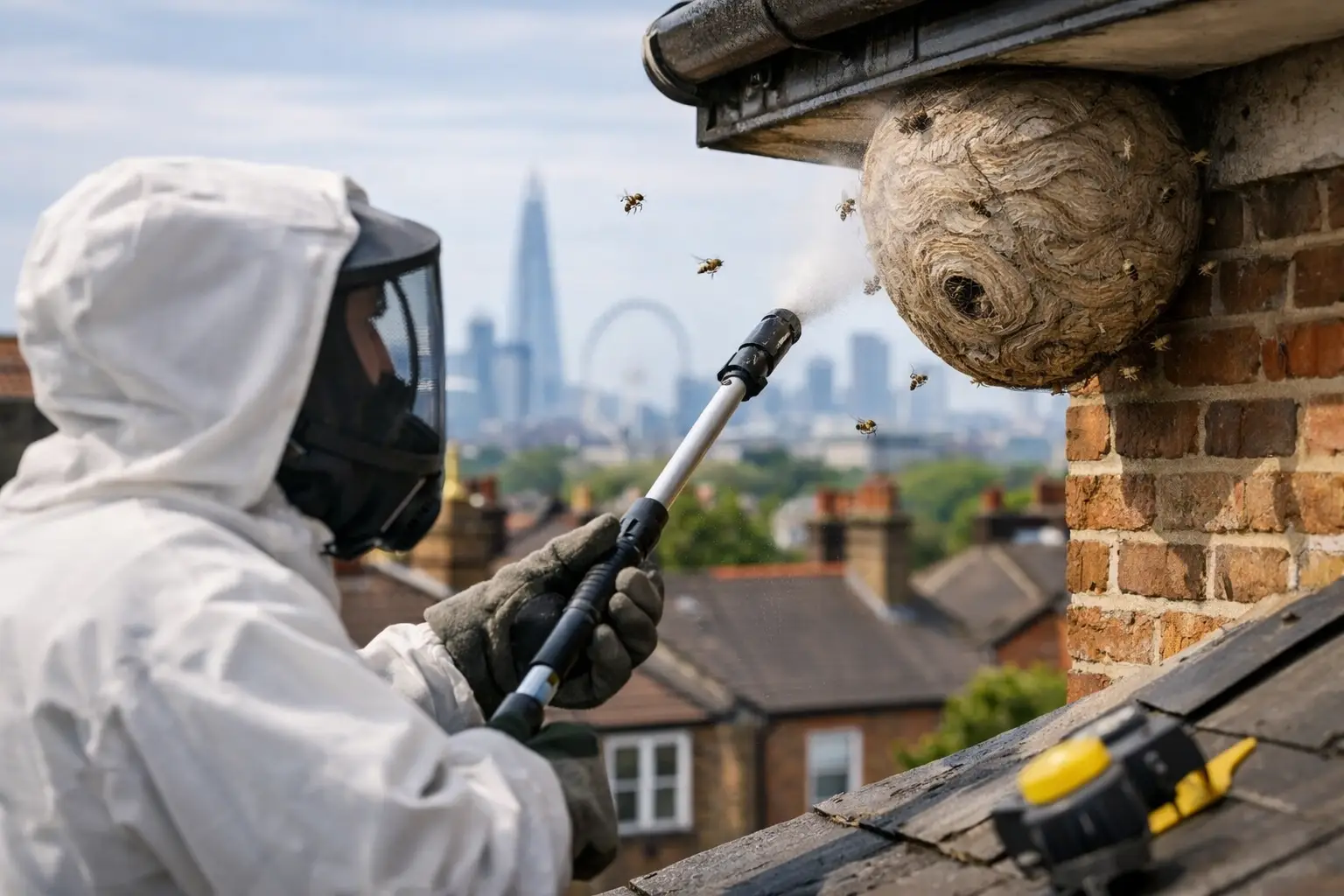
A wasp nest above the front door, inside a loft or beside an outdoor seating area can turn an ordinary day into a safety concern very quickly. Wasp nest removal cost is usually the first question people ask, but the right price depends less on the insect itself and more on where the nest is, how safely it can be treated and how urgently help is needed.
For most homes, professional treatment is a straightforward, one-visit job. Where access is awkward, residents are at risk of stings, or a business needs prompt action to protect staff and customers, the work can require more planning. A clear quote should explain what is included, rather than leaving you to guess why the price has changed.
Typical wasp nest removal cost in London
In Greater London, a standard treatment for one accessible wasp nest often falls in the region of £60 to £120. This generally covers a qualified technician attending the property, assessing the nest, applying an appropriate insecticidal treatment and advising you on what to expect afterwards.
Prices can rise to around £120 to £250 or more where a nest is high up, concealed in a roof space, located behind cladding, or requires specialist access equipment. Same-day and out-of-hours visits may also carry a higher charge, particularly during the busiest part of the wasp season.
Commercial premises are commonly priced following an assessment. A small nest outside an office may be simple to resolve, while a nest near a restaurant entrance, school area, warehouse loading bay or customer seating space needs a treatment plan that considers public safety, access and operating hours.
The cheapest quote is not always the best value. Ask whether the price includes the call-out, treatment, any required follow-up, and advice if wasp activity continues for a short period after treatment. A professional service should be clear about this before work begins.
What affects the cost of wasp nest removal?
Nest location and access
An exposed nest on a low shed is far easier to treat than one hidden under roof tiles or in a chimney void. Technicians must be able to reach the nest, or reach an appropriate treatment point, without putting occupants, neighbours or themselves at risk.
Work at height may require ladders, roof access equipment or additional safety measures. Nests in lofts can also take longer to assess, especially where insulation, restricted crawl spaces or electrical cables limit safe access. These practical factors are often the main reason one wasp job costs more than another.
Number of nests and level of activity
A property can occasionally have more than one active nest, particularly around detached homes, gardens and commercial grounds. Wasps may be entering through separate gaps in soffits, vents or wall cavities, making it necessary to inspect the full area rather than treating the first visible flight path.
A large, highly active colony may need a more cautious approach, especially if it is close to doors, windows or communal areas. The aim is not simply to spray and leave. It is to control the colony safely while reducing the chance of stings or disturbed wasps entering the building.
Timing and urgency
Wasps are most active from late spring into early autumn, with activity often peaking in July, August and September. During this period, urgent appointments can be in high demand. If wasps are entering a child’s bedroom, gathering near a business entrance or threatening someone with a known severe allergy, a rapid response is worth prioritising.
Emergency availability can affect the final price, but it also reduces the time a dangerous situation is left unmanaged. For landlords and facilities managers, fast attendance can be particularly valuable when tenants, visitors or staff are exposed.
Type of property
Flats, terraced houses, large detached properties and commercial sites all present different access challenges. A nest in a shared block may require coordination with a managing agent or neighbour, while a nest in a restaurant garden needs careful timing to avoid disrupting customers.
Some treatments also need to account for pets, young children, food-preparation areas or sensitive working environments. This does not automatically make the job expensive, but it can change how treatment is planned and carried out.
What should a professional wasp treatment include?
A proper service starts with identification and assessment. Bees, wasps and hornets should not be treated as though they are the same problem. Honey bees are valuable pollinators and may need a different approach, while hornets are larger and can be more intimidating but are often less aggressive unless their nest is disturbed.
For an active wasp nest, the technician will identify the entry point and use a suitable professional treatment. In many cases, the nest does not need to be physically removed straight away. The treatment is applied at the entrance, and worker wasps carry it into the colony.
You may still see wasp activity for several hours, and sometimes up to 24 to 48 hours. That does not necessarily mean treatment has failed. Wasps that were away from the nest when it was treated can return later. You should avoid blocking the entrance immediately, as this may force surviving wasps into another part of the property.
Once activity has stopped, a technician can advise whether nest removal is necessary. In an inaccessible void, the old nest is often best left in place because wasps do not normally reuse it the following year. If it is in a visible or vulnerable area, removal may be appropriate once it is safe to do so.
Why DIY removal can cost more in the end
Shop-bought sprays may look like a low-cost answer, but they are rarely suitable for nests in eaves, lofts, wall cavities or high locations. Getting close enough to spray a nest can provoke a defensive swarm, and treating only the surface may not deal with the colony properly.
DIY attempts can also drive wasps further into a building. Sealing a hole while the nest is still active is a common mistake, particularly around roof lines. The insects may then search for another route and emerge inside a bedroom, loft or living area.
There is also a safety question. Anyone with a history of severe allergic reactions should not attempt to handle a nest. Keep children and pets away from the area, close nearby windows where practical, and arrange professional help. A controlled treatment is usually more cost-effective than paying for an urgent visit after a failed attempt.
How to keep the quote fair and clear
When requesting a price, describe the nest location as accurately as possible. Mention whether it is visible, how high it is, whether wasps are entering the building and if anyone has been stung. A clear photograph from a safe distance can help a provider judge access, but never climb, lean out of a window or approach the nest to get one.
It is sensible to ask whether the quote is for one nest, whether VAT is included where applicable, and what happens if activity remains after the stated treatment period. For a business, ask how the visit will be managed around customers, food service or staff access. Clear answers prevent surprises and help you compare services on more than a headline figure.
Golden Pest Control provides professional wasp treatment for homes and businesses across London, including urgent situations where an active nest is affecting daily life or safe access to a property.
When to arrange treatment without delay
Do not wait for a nest to become larger if it is close to a frequently used entrance, a children’s play area, an outdoor dining space or an open window. Prompt treatment is also advisable when wasps are entering indoor rooms, when you cannot locate the nest but activity is increasing, or when a resident has a serious sting allergy.
If the nest is well away from people and there is little activity near the property, you may have more flexibility over appointment timing. Even then, avoid disturbing it. Wasps become more defensive when they believe their colony is under threat.
A fair wasp removal price is one that reflects safe access, effective treatment and straightforward communication. The immediate goal is to make your property safe again, so you can use your home, garden or business premises without planning your day around a nest.